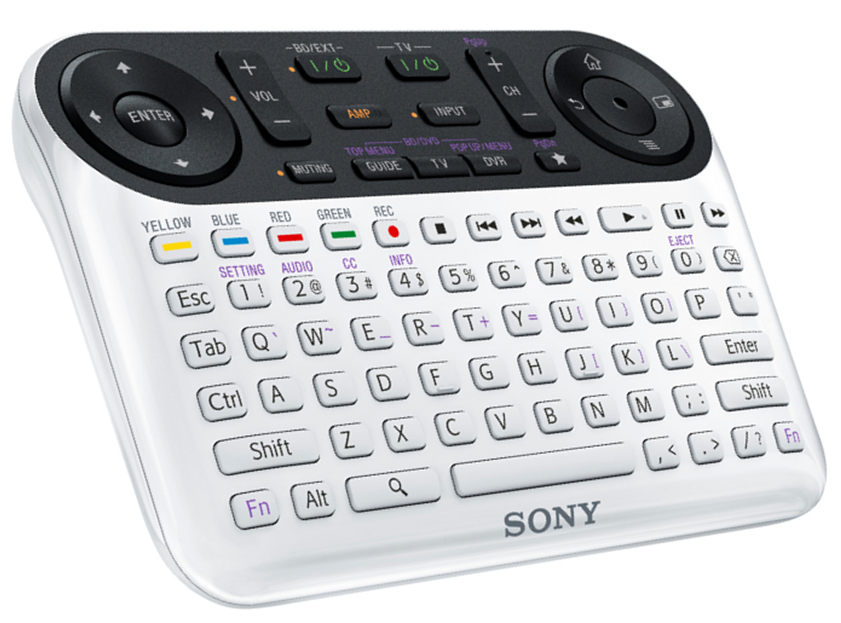
Sony’s Google TV remote control – lots of buttons, but not the ones you need.
Google Now may have just won Popular Science’s “Innovation of the Year” award, but it is receiving no accolades for Google TV. With Logitech leaving the party licking its wounds with more Revue boxes being returned from retailers than are being sold and Google refusing to unveil sales figures in the face of Apple’s 500,000 units ($260M) per quarter, it is putting a brave face on things by “trying and trying again” in the hope of one day upsetting Apple’s cart.
In short, Apple’s TV “hobby” is considered a moderate success, whereas Google’s concerted TV effort is considered a resounding fiasco.
In spite of Google’s limitless cash and brainpower, Google TV has been universally side-stepped by the buying public for two very simple reasons: a clumsy user interface and a lack of compelling content.
After Apple’s runaway success with iTunes, TV broadcasters such as cable, movie studios, and other providers are understandably reluctant to allow their content to be delivered through new channels they don’t control. And TV broadcasters snubbed Google TV big time. But that isn’t the real problem.
Licensing content is not an impossible task—it’s merely a matter of finding the right balance of sharing profits to everyone’s satisfaction. Success stories such as cable companies, Netflix, Hulu, and, yes, Apple, demonstrate that you can buy the rights to stream video. Apple TV’s moderate success has much to do with its relationship with Netflix.
No. The real problem with Google TV is its clumsy user interface. And it is awful. People don’t want products that are difficult to use – it’s as simple as that.
When you interact with the Internet, you need a keyboard and mouse. If you mash in a TV remote, you get a monster like the Sony unit featured above. Lots and lots of pretty buttons, but not the ones that get real things done.
The two green buttons top center for instance, power on the DVD player and TV, but that’s it. Neither the DVD nor any TV show will appear on your screen after pressing those buttons. Instead, you’ll see a screen saver and a ribbon of icons that you must navigate to select “Live TV.” Watching a DVD is even more painful; it’s hidden in a sub-menu. And the mouse pad (upper right) is both jittery and sluggish; it can take 10 seconds to move the mouse cursor across the screen.
Google TV failed due to poor ergonomics – something Apple is a master at. Success is down to an enjoyable user experience and compelling content, two things Apple knows how to do well. It comes as no surprise that it is developing its own bona fide HDTV planned for 12 months time.
They Will Converge
Nobody doubts that TV and the Internet will converge. The benefits are clear. Imagine entering a search term such as “Downton Abbey” and seeing results that include any episodes previously recorded on your video recorder, the show’s current TV schedule, and Web pages that reference the show. Ironically, Google TV does this quite well.
Steve Jobs said he had solved the Internet/TV interface problem in a biography by Walter Isaacson published earlier this year:
“(Jobs) very much wanted to do for television sets what he had done for computers, music players, and phones: make them simple and elegant. ‘I’d like to create an integrated television set that is completely easy to use,’ he told me. ‘It would be seamlessly synced with all of your devices and with iCloud….It will have the simplest user interface you could imagine. I finally cracked it.’”
Most observers think he envisioned a Siri-like voice command system. That would avoid the keyboard/mouse/remote horror.
Rendez-vous Christmas 2013 – date when Apple is rumoured to launch its first HDTV sets.
 The Fourth Column
Leave a comment