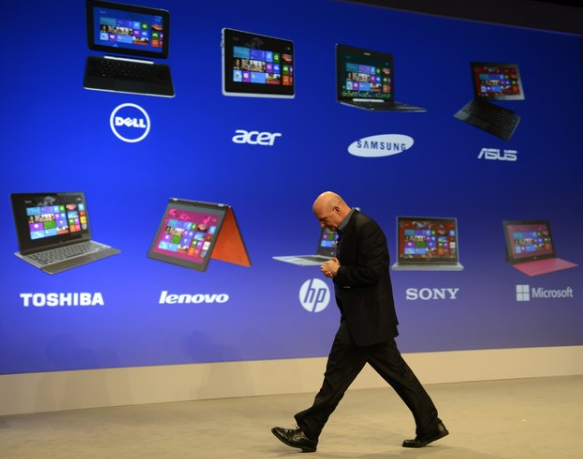
Steve Ballmer shattering perceptions and kicking Microsoft into a ‘new era’
Steve Ballmer, CEO Microsoft, announced availability of Windows 8 yesterday “shattering perceptions of what a PC is” and “kicking off a new era” for the company.
Having completely missed the smartphone and tablet movements (along with Intel), it certainly needed a good kick as it attempts to make its comeback with an operating system that purports to bridge ‘need’ with ‘desire’.
The ‘need’ is for every day work, represented by Office and all those other applications we use on our desktops at work. The ‘desire’ is what drives our passion: music, cinema, TV, books, photos, beautiful art, memories. Microsoft tries to do with one (Windows 8) what Apple purposely does with two (Mac OSX and iOS).
Will it succeed? I am not convinced. It’s not that I think Windows will disappear from the desktop, far from it, but I do think Windows 8 will be slow coming to it. Windows’ strength is in the enterprise and I really don’t see the need to swipe my 24” monitor – it’s a bit far away for starters and I have a mouse that does that job better. And anyway, it would leave greasy marks I’d need to frequently clean. Wiping a 24” monitor is a bit of a chore compared to my 4” smartphone that granted I do clean every now and again. Silly but true. Alright, so I could wear latex gloves to work. But that would raise eyebrows. In my view, Windows 8’s true home is the Surface tablet, and yet with its 16:9 aspect ratio, it’s a little uncomfortable to hold and use on your lap and a little tall in portrait mode. It’s better off being used on a desktop. Hmmm.
Some industry pundits question the virtues of trying to bridge the two worlds too. We’ll see.
The real question is: does the operating system really matter anymore? Even Microsoft is abandoning its heritage APIs in favour of industry standards HTML5 and CCS3. These are far better suited to the lightweight world of orchestrating mobile application architectures. As mobile applications gather more and more critical mass, the operating system is fast being relegated to second fiddle.
Cloud visionary Marc Benioff, CEO of Salesforce.com rather provocatively considers Windows 8 to be ‘the end of Windows’. He cites his customer’s resistance to Windows 8 as the reason. Even if you might find him a trifle partisan, his words carry weight among CIOs and CEOs.
“Windows 8 is the gambit — will [CIOs] upgrade, or will they do something else?” Benioff said. “It’s the end of Windows. … Windows is irrelevant.”
A recent Gartner report reinforces the view that mobile apps is where the R&D dollars are going, predicting that 80% of new application development in the enterprise is for smartphones and tablets come 2015.
“Gartner also predicts that mobile AD projects targeting smartphones and tablets will outnumber native PC projects by a ratio of 4:1 by 2015.”
The good news for technology geeks is that when it comes to mobile, we are only scratching the surface. These next few years are going to herald some exciting developments. I see three major technology axes:
- Portability. Today’s portable devices are light and easy to carry around; it is the reason for their success. They are going to get lighter and lighter, perhaps even change form factor. Flexible screens are coming soon, reducing weight further. Imagine a screen as a film rolled up like a drinking straw, worn on your wrist, superimposed on your car windshield or in your glasses. Prototypes of all these ideas exist already. Imagine your hand as the keyboard with the CPU tucked in your pocket connected via ultra high-speed-Bluetooth.
- Power. Microsoft’s Surface delivers 7 hours of battery life. Apple’s iPad delivers 10. It’s still not enough. Apple filed a patent for a fuel cell that could turn hours into weeks. Now that’s a lot better for business applications.The battery has remained fundamentally unchanged since it was invented by Volta in 1800. That explains why big R&D money is now being channeled towards breakthrough technology. Possible solutions include lithium-air, fuel cells, nano tech, micro fusion, or even Tesla-inspired wireless transmission from the power grid. Just as the Cloud is eliminating the need for portable hard drives, so too could the grid ultimately eliminate batteries!
- Convergence. Apps in smart phones and tablets are eliminating entire manufacturing industries. Many devices have already been absorbed into smart phones—radios (FM, SW, scanners, and weather), calculators, audio books, answering machines, voice recorders, and so on. Other gadgets are in the process of being absorbed: sat-navs, game consoles, cameras (underwater), universal remote controls, credit cards, weather stations, the list of potential apps is in fact endless.
The computer industry has been talking about ‘thin-clients’ and ‘network computers’ for over 15 years. The battle between Apple, Amazon, Google, Microsoft and Samsung for mobile domination is driving the technology research exponentially. It appears that Engineering is finally catching up with Marketing.
Microsoft shareholders beware.
 The Fourth Column
Leave a comment