
Project Glass in Free Fall
In the race to trump Apple’s run-away success, Google jumped out of a blimp, mountain biked across the roof of the Moscone Center, ran down the side of its walls, right into Sergey Brin’s keynote speech, all to showcase Project Glass yesterday at its 2012 I/O developers conference. Project Glass is a prototype input and output device resembling a pair of spectacles, designed to ‘let technology get out of the way‘ of living life to the full. In the future they risk being as pervasive as mobile phones – so be warned.
This was most certainly the highlight of a 2 hour keynote speech, which could otherwise have been cut and paste from last week’s Microsoft Surface announcement, which itself seemed to have been cut and paste from a variety of previous Apple announcements.
Which all goes to prove the theory that the only way to deep shareholder happiness is to totally own the doorway to the Internet; increasingly being visited through mobile devices governed by proprietary operating systems that control social networks, Cloud apps and consumer content. Hardware, software, services and content. Vertically integrated. Apple got there first. then Microsoft and now Google.
Will Google succeed?
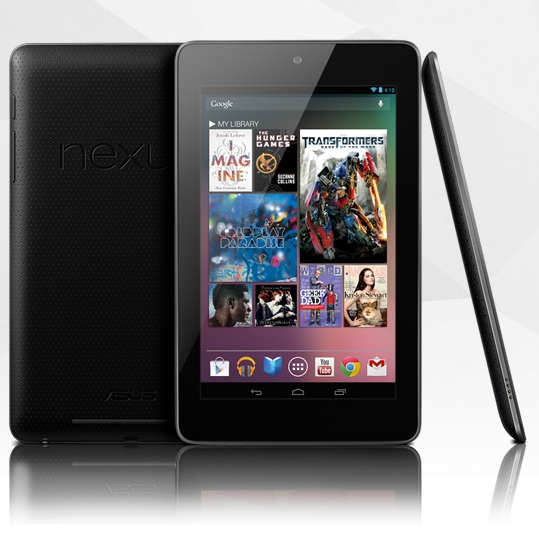
Google’s Asus built, Nexus 7
The Nexus 7 looks like a neat enough device and priced at only $199 should sell well for that reason alone. Will it displace the Kindle Fire and the iPad? Maybe the former, but I doubt the latter. Google’s strategy here is to co-brand a device manufactured by Asus, sell it at cost and reap the profits from the sale of consumer content.
Sounds familiar? This is exactly Amazon’s strategy with the Kindle Fire – its most immediate competitor. The success of displacing Amazon or Apple for that matter, will depend on the quality of Google’s content ecosystem. I suspect that Amazon’s and Apple’s ecosystems are broader and deeper and benefitting from improved terms and conditions after this announcement. Unlike Google and Amazon, Apple does make decent money on its tablet hardware. Apple’s drive into the home with cross device pollenation through iCloud will make it both difficult to dislodge and resistant to price erosion.
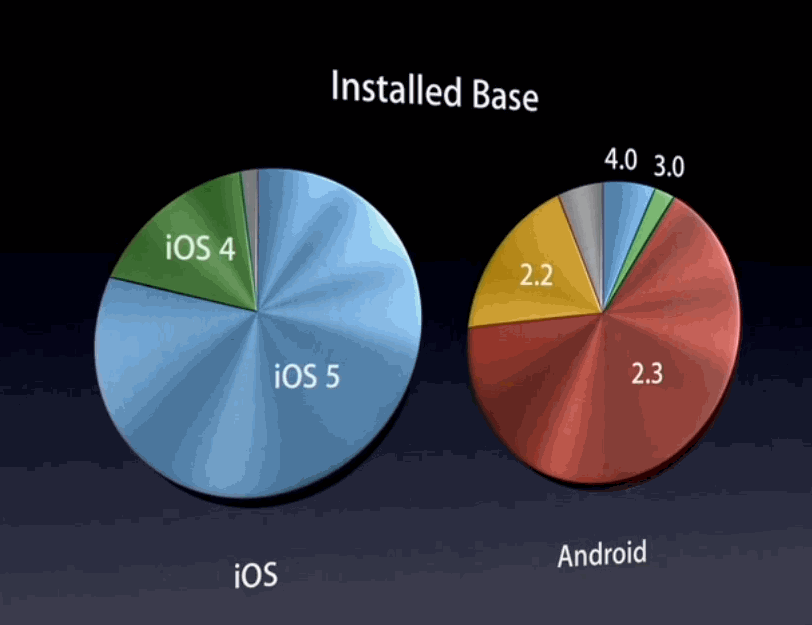
Installed bases: iOS 5 versus Android 4.0
But here’s the main challenge for Google. Developers need large, homogenous installed bases to maximize their return on investment for any given platform. Android is very fragmented. Today Gingerbread (Android 2.x) is still two thirds of its installed base. whereas Ice Cream Sandwich (4.0) is less than 10%. The sex and sizzle is in ICS and this latest Jelly Bean (4.1) release. So while Google developers may have fun with Jelly Bean, they are unable to take full advantage of it if they want to make money. And therein lies the rub. Only Apple’s iOS enjoys a rapid refresh of its installed base with a staggering 80% at the latest release – a point it was keen to point out in its recent 2012 WWDC iOS6 announcement. It’s one of the reasons why enthusiasm has waned from 90% of the development community aspiring to Android projects over a year ago to less than 80% today.
This announcement creates something of a dilemma for Microsoft. It needs to price Surface RT to compete with the Nexus 7 and at the same time ensure it doesn’t undermine its own OEM partners tablet efforts. Remember Microsoft is really targeting the iPad and the Nexus 7 is way below that in terms of price. Let’s not forget that its OEMs have a Windows 8 license to pay for that Microsoft obviously hasn’t. At these price levels, that’s a significant cost on the BOM – a point I am sure being hotly debated as we speak. Expect some OEM vendors to throw in the towel on tablets. Expect Apple to respond with its seven inch iPad too. There’s nothing like a bit of competition to get things rolling along.
In a year from now, the world of tablet computing will comprise just three platforms. In order of superiority: Apple with iOS will be (way) out in front, Google with Android will follow suit with Microsoft Windows Metro 8 a very distant third.
Check in a year from now to see if I was right.
 The Fourth Column
Leave a comment